BIOGRAPHY
HISTORY
Nadia Cascini was born in Arezzo in 1970, daughter of two goldsmiths. Her passion grows up, attending Arezzo’s Art College and graduating in the Metal and Jewellery sector. During her studies, she started dealing with painting, improving her painting skills thanks to some drawing schools in Arezzo.
In the second half of the 80’s she started to join hundreds of painting competitions, all around Italy and she gained the first place in most of them. In 1999, in Marina di Ravenna, she was awarded twice: she was the only woman (in 90 competitors, in 46 competitions) that won.
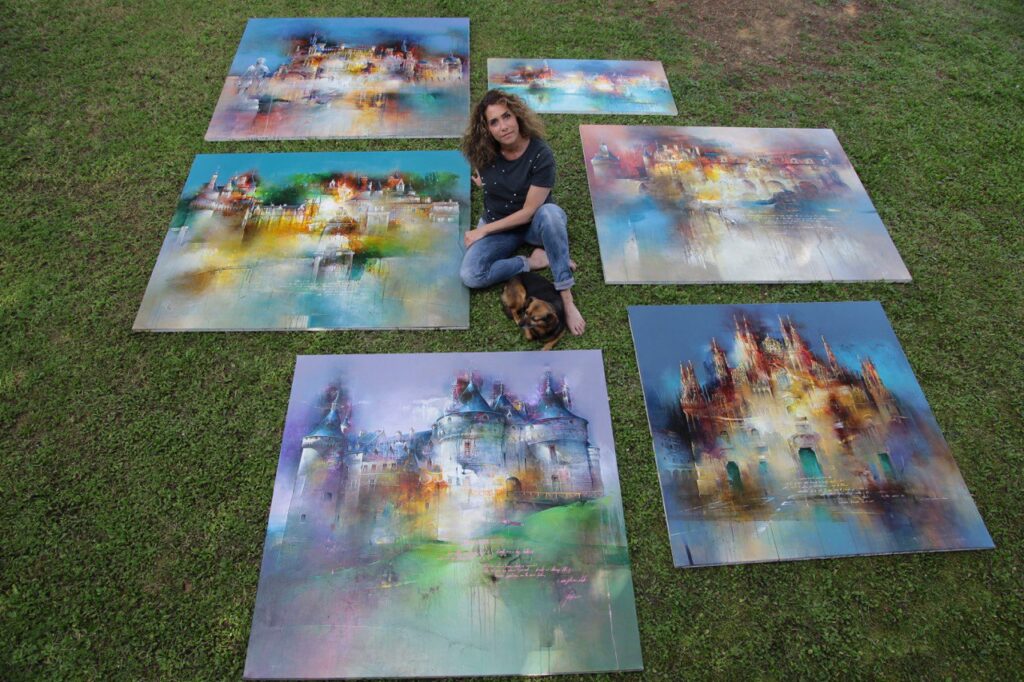
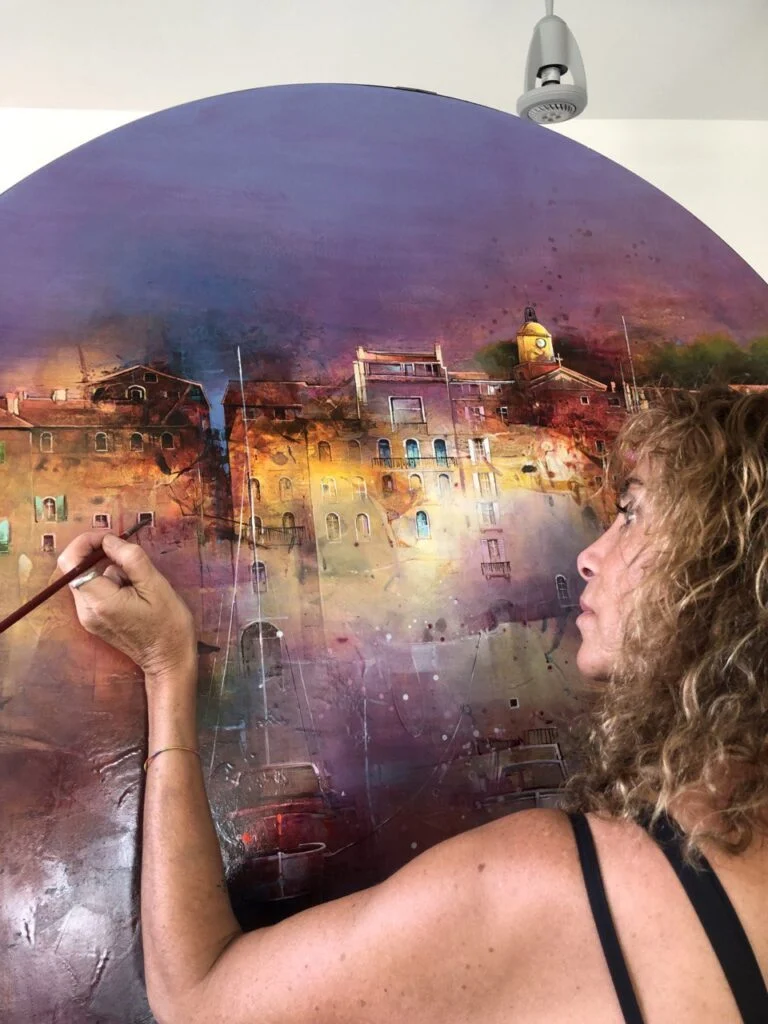
In the second half of the 90’s Nadia worked with French, Spanish, German and Dutch art galleries, exposing landscape, composition, figurative paintings and her precious Venice that makes in years deep and personal. Nadia works, after a general overview, on the lights, overlaying many layers of color sequentially. She also mixes different framings in the same space and this gives a dynamic, incorporeal nature in her paintings. The world she paints is a fusion between the real world, the imaginary and the magic one. Through the oil painting, Nadia Cascini, makes an overlay of particular shades, realizing amazing works full of mistery. With every soft brush stroke she does create artworks full of personality. Nadia is constantly in search of armony; her subjects are all connected with poetry.For many years now, her painting can be found in important art galleries in Singapore, New York and in all Europe.
“A generous girl from Tuscany” was what they called me
20 years ago, back when I started out on my artistic
adventure. My native land taught me everything,
enveloping me in its colours and teaching me to think
through images.
I am a painter, essentially, and every time I paint, my voice
shifts to my hands to speak of myself and my perfect
world. My eyes filter images, memories and thoughts
that, in colours, take a different form each time. They cannot
be repeated. That would be like wanting to live the same
moment twice.
There are moments when I’m painting when everything fades
away and noises disappear, and the only thing that remains is
me and my canvas, which tells me what to do. And I obey.
In each colour lies the structure of the final image, in each detail
the connection to the objects that surround me.
The uniqueness of a work of art resides in how much chance
it contains. The chance I seek, the chance I find. The chance I
pursue and that lets itself be captured – if it so desires.
The observing eye will never be able to perceive everything,
since my memory is based on layers of colours and changes
with every shift in light. This is vital for me and has been ever
since I was drawn to the reflections of gold and metals.
For me everything is light – overbearing, fractured, smoky,
violent or soft, diluting in the warmest shadows with the orange
earth and colours, recollections of my memories and life.
“I paint” and when I think about it, I don’t think I could have
done anything else. It is how I communicate what I don’t
know how to say in words. I focus on the land and the sea
rather than everyday objects with my shifting moods and I
have to turn them into their quintessence, past, present or
future.
Each of my shapes contains a multitude of superposed and
fragmented colours. The more the colours take over the
model, the greater my satisfaction; the more the shapes
disintegrate, wilt and soften, the more elevated my painting.
The structure hides. Between light and darkness, colours and
chance, it slowly reveals itself and attracts the eye. It then
becomes more emphatic, underlined by the strongest light,
and the gaze wanders across its surface.
I seek to bring the onlooker a poetry penned by the tip of my
paintbrush, which when it touches the canvas produces a
gentle melody.
I remodel my archetypes daily, since for me life, like art, is an
“indistinct contour” bordering on dreams and emotions.
Creating is as essential for me as is living: this for me is the key
to all connections, the cornerstone of my thought – what I
have always had and always had to do: paint.